
Tone Forge vs VCV Rack and Vital: Offline Modular Synth Comparison
Compare Tone Forge, VCV Rack, and Vital across patch-graph clarity, Windows VST3 support, Linux standalone workflow, CPU footprint, and one-time licensing.
Musicians shopping for a desktop modular synthesizer usually end up comparing three distinct styles of instrument: a sprawling virtual Eurorack cabinet like VCV Rack, a modern wavetable workhorse like Vital, or a focused native patch-graph instrument like Tone Forge. Each tool solves a real sound-design problem, yet their everyday workflow, DAW plugin access, and licensing trade-offs are very different once you sit down to build playable patches.
This comparison breaks down how Tone Forge, VCV Rack, and Vital behave on real Windows and Linux studio machines so you can pick the instrument that matches how you design sounds and finish tracks.
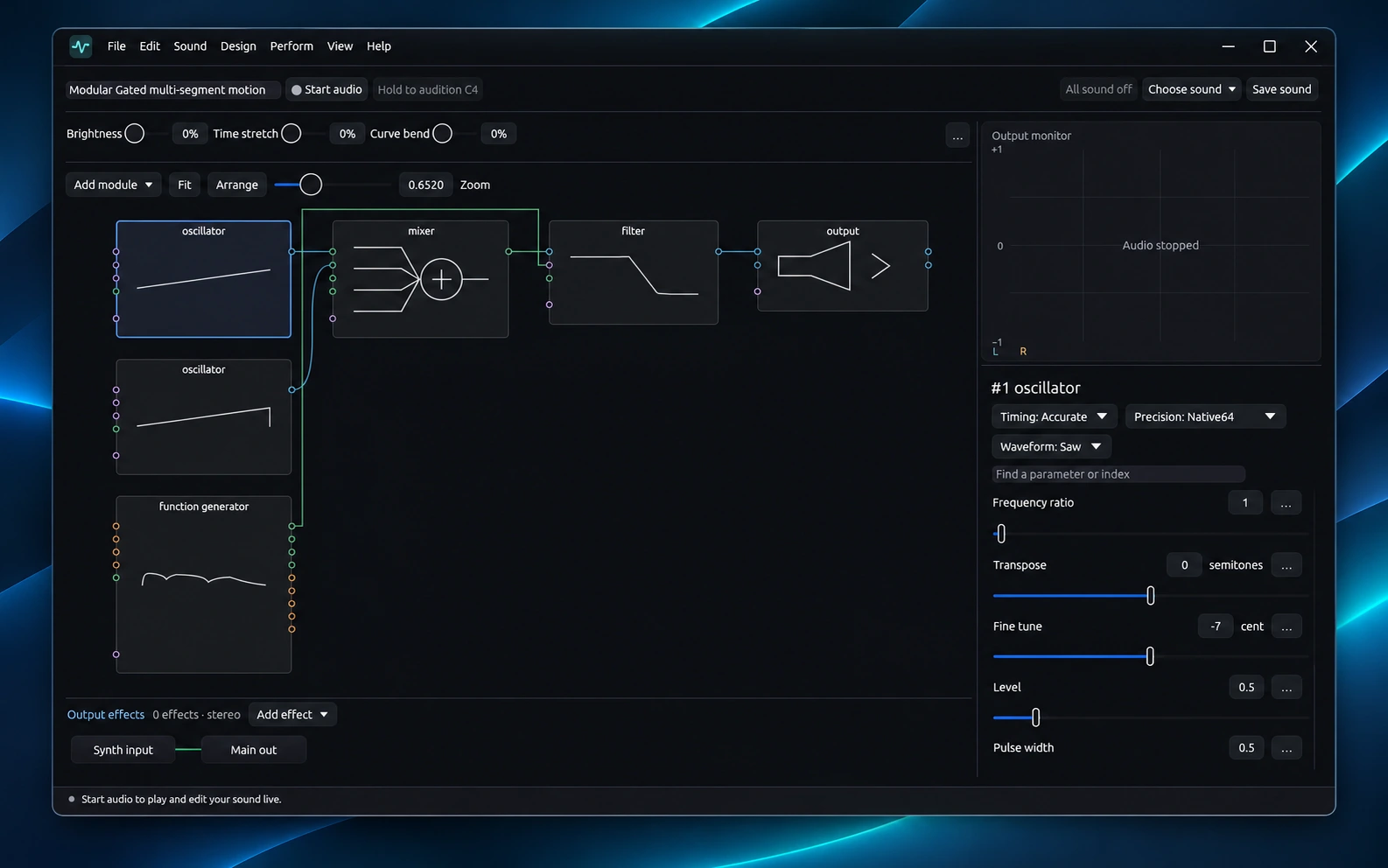
Side-by-side comparison at a glance
| Evaluation area | Tone Forge | VCV Rack (Free / Pro) | Vital |
|---|---|---|---|
| Primary workflow | Focused node-and-wire modular patch graph | Virtual Eurorack rack with hundreds of third-party modules | Fixed-architecture wavetable synthesizer with drag-and-drop modulation |
| Windows VST3 plugin | Included in both Windows direct installer and Microsoft Store build | Requires paid Pro tier for DAW plugin hosting | Included in standalone and plugin formats |
| Linux standalone | Native AppImage, DEB, and RPM | Supported standalone desktop build | Supported Linux build |
| Patch readability | Direct graph trace from oscillators through mixer, filter, and stereo effects | Realistic cable rack that can grow dense quickly on complex patches | Structured tabs for oscillators, effects, and modulation matrix |
| Offline operation | 100% local audio and preset storage; no cloud account required | Core runtime runs offline; library browsing uses an online account | Account login typically used for cloud preset packs and downloads |
| Pricing & licensing | Free Community edition; one-time Professional (1 device) and Team (3 devices) website licenses; Store permanent unlock | Free standalone; commercial Pro edition priced significantly higher for VST/AU/CLAP | Free base tier with optional paid tiers or subscription preset access |
Patch clarity vs. module sprawl
VCV Rack excels when your goal is emulating an entire hardware Eurorack wall and experimenting with hundreds of community-built utility modules. The trade-off is visual density: even a two-oscillator voice with a modulated filter, stereo chorus, and velocity envelope requires scrolling across rack rows and tracing overlapping patch cords.
Vital sits at the opposite end of the spectrum. Its three wavetable oscillators, dual filters, and modulation rings are fast for modern EDM basses and lush pads, yet the signal routing stays largely fixed inside predefined tabs.
Tone Forge occupies the practical middle ground. Every oscillator, mixer, filter, multi-segment function generator, modulator, and stereo output effect appears as a clean node in one continuous patch graph. You can immediately see which wires carry audio and which routes modulate parameters like filter cutoff or gain. When a patch suddenly goes silent or sounds static, tracing the path from source to output monitor takes seconds rather than digging through hidden matrix pages.
Windows VST3 and Linux standalone support
One frequent frustration with modular synthesis is losing DAW integration unless you buy an expensive pro bundle. Tone Forge avoids that split on Windows: both the official Tone Forge download page Windows x64 installer and the Microsoft Store build deliver the standalone desktop synthesizer together with its matching Windows VST3 instrument plugin.
On Linux x64, Tone Forge ships as a native Rust and egui standalone synthesizer packaged as AppImage, DEB, and RPM. Because it runs without an Electron browser layer or background DRM helper, startup is near-instant on modest studio laptops as well as workstation desktops.
Live auditioning and envelope sculpting
Good sound design relies on fast A/B listening. Tone Forge pairs live parameter inspection with a dedicated Hold to audition C4 control alongside full MIDI keyboard input. You can sweep filter cutoff, reshape a six-segment envelope, or toggle dry and wet stereo effects while holding the exact same reference pitch—making harmonic changes unmistakable before you ever record a bar.
If you want to try that workflow step by step, walk through the first modular patch guide, the filter cutoff and resonance reference, and the envelope shaping guide.
Pricing, privacy, and ownership
Many modern soft synths push players toward monthly subscriptions, online preset launchers, or tiered upgrade packs. Tone Forge keeps its licensing simple and predictable:
- Community Edition (Free forever): Build modular graphs, connect oscillators, filters, modulators, and output effects, and audition patches live with zero time limits.
- Professional (1 device) & Team (up to 3 devices): Direct one-time website licenses (see the Tone Forge license page for current pricing) unlock saving and loading custom patch files and sound libraries, with online email/key activation or offline license file import.
- Microsoft Store Edition: Offers a single permanent unlock priced in your local currency through your Microsoft account, sharing entitlement between the standalone synthesizer and the Store VST3 plugin.
No patch data, audio buffer, or usage telemetry leaves your machine.
Which synthesizer should you choose?
- Choose VCV Rack if you specifically want Eurorack hardware module cloning and third-party module ecosystems.
- Choose Vital if your main priority is wavetable morphing, spectral warping, and modern pop/EDM preset packs.
- Choose Tone Forge if you want a fast, readable native modular patch-graph synth with multi-segment envelopes, stereo output effects, Windows VST3 included, offline privacy, and an affordable one-time license.
Download Tone Forge free on the Tone Forge download page, review licensing options on the Tone Forge license page, or read the virtual modular signal flow walkthrough. You can also read the Simplified Chinese edition of this comparison.