
Tone Forge vs Surge XT and Cardinal: Modular Synth Guide
Compare Tone Forge, Surge XT, and Cardinal on patch graph readability, Windows VST3 and Linux standalone support, CPU load, offline use, and licensing.
Desktop producers looking for an offline synthesizer without subscription baggage frequently narrow their shortlist to three capable instruments: Surge XT, Cardinal, and Tone Forge. Each runs locally on Windows and Linux workstations without cloud logins, yet their architectures, visual ergonomics, and studio roles diverge sharply once you begin building playable patches under deadline.
This guide evaluates Tone Forge alongside Surge XT and Cardinal across patch-graph readability, Windows VST3 and Linux standalone deployment, CPU headroom, and long-term licensing clarity so you can match the tool to your actual workflow.
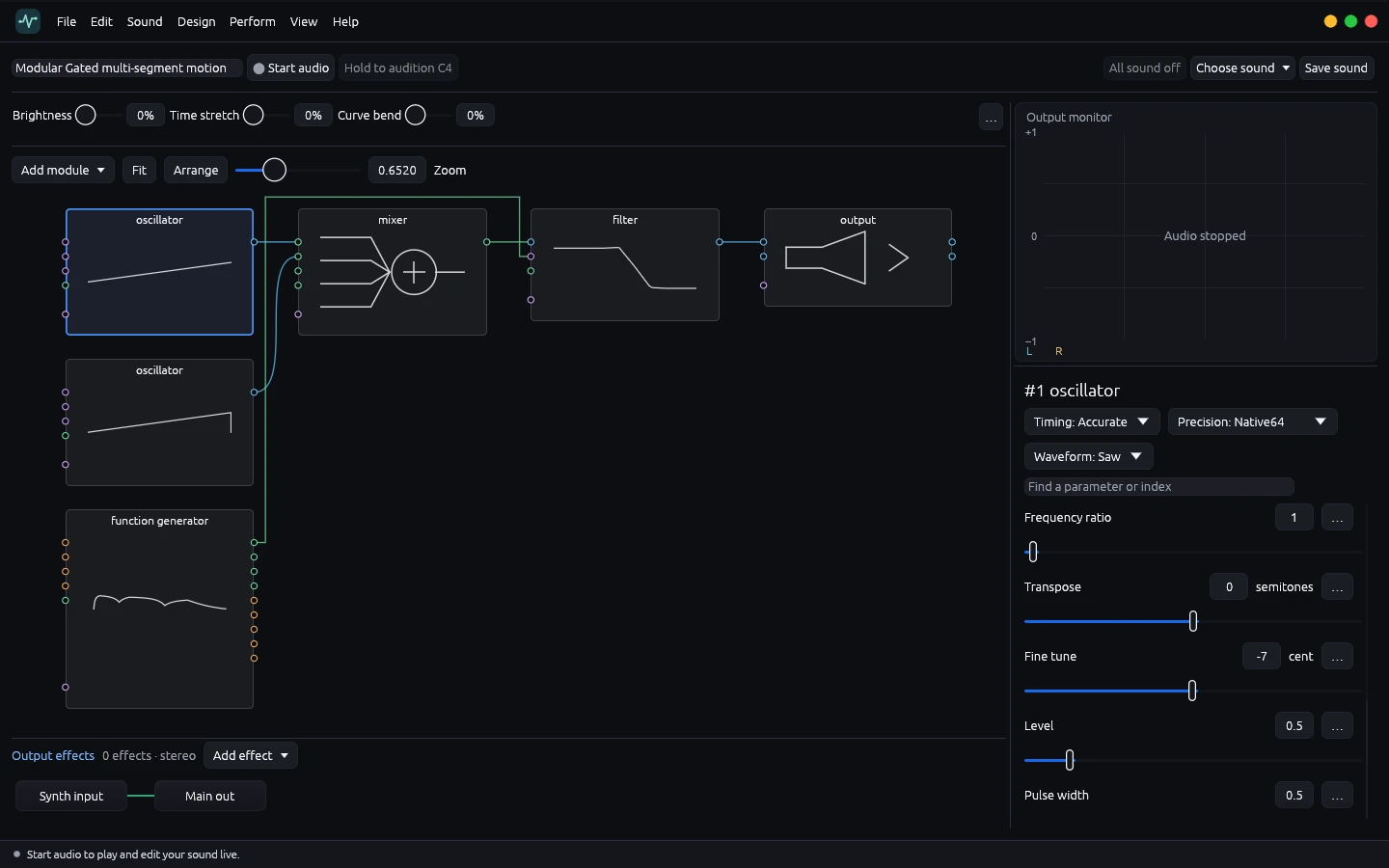
Architecture and workflow comparison
| Dimension | Tone Forge | Surge XT | Cardinal |
|---|---|---|---|
| Synthesis layout | Clean node-and-wire modular patch graph with side inspector | Dual-scene hybrid subtractive and wavetable panel synth | Virtual Eurorack cabinet bundling fixed open-source rack modules |
| Signal readability | Explicit audio and modulation leads on one flat canvas | Fixed block diagram with color-coded click-to-assign modulators | Multi-row hardware faceplates connected by draping virtual cables |
| Windows DAW plugin | Windows x64 VST3 bundled in direct installer and Microsoft Store | Open-source VST3, CLAP, and standalone builds | Open-source VST2, VST3, CLAP, LV2, and standalone builds |
| Linux desktop run | Native Rust and egui standalone via AppImage, DEB, and RPM | Native Linux standalone and plugin packages | Native Linux standalone and plugin builds |
| Audition ergonomics | Built-in Hold to audition C4 control plus live MIDI keyboard input | MIDI input and on-screen virtual keyboard across dual scenes | External MIDI or rack-mounted sequencer and keyboard modules |
| Licensing model | Free Community edition; one-time Professional and Team website licenses; Store permanent unlock | Open-source GPLv3 with zero paid tiers | Open-source GPLv3 self-contained rack distribution |
Patch graph readability against dense panels and racks
Surge XT is an extraordinary hybrid synthesizer with twelve oscillator algorithms, dual scenes, microtuning tables, and deep effects chains. Its challenge for learners and fast sound designers is panel density: dozens of sliders, scene toggles, and hidden modulation slots compete for attention on one screen. Tracing why a timbre shifts mid-bar often means hovering over modulation routing bars and stepping through scene tabs.
Cardinal solves the commercial plugin paywall of classic virtual Eurorack by packaging a large fixed set of open-source modules directly inside a DAW-ready rack. Even so, it inherits the visual trade-offs of a skeuomorphic modular wall. Building a filtered polyphonic voice with a custom contour and stereo space quickly spans multiple rows of rotary knobs, tiny jack labels, and overlapping patch cables that obscure parameter readouts.
Tone Forge takes a deliberately uncluttered approach. Oscillators, mixers, low-pass filters, six-segment function generators, and the output module sit as clean geometric nodes on one readable canvas. Selecting any module opens its parameters right next to the graph, while the stereo Output effects lane stays neatly separated underneath. When you teach synthesis or refine a bass tone mid-mix, you can verify both the audio path and every modulation destination in a single glance.
Windows VST3 plugin integration and Linux standalone speed
Workflow friction often appears when you move from sketching sounds standalone to recalling them inside a real mix session. On Windows x64, both the direct installer on the Tone Forge download page and the Microsoft Store edition package the standalone desktop synthesizer together with the matching Windows VST3 instrument plugin. You sculpt a patch in the same interface whether you are improvising standalone or automating cutoff inside a Windows DAW.
On Linux x64, Tone Forge ships as a native Rust and egui standalone application in portable AppImage, Debian/Ubuntu DEB, and Fedora/openSUSE RPM formats. There is no browser runtime, no background update daemon, and no external module store to synchronize before opening a session. Surge XT and Cardinal also provide strong Linux support, though Cardinal's large rack asset footprint takes longer to load when you only need one focused modular synth voice.
CPU footprint, offline reliability, and studio longevity
All three synthesizers run completely offline on your local processor with zero mandatory accounts or cloud telemetry. Where they differ in daily studio use is operational focus and predictable resource usage:
- Focused voice architecture: Because Tone Forge renders a curated native DSP graph rather than hundreds of disparate third-party rack modules, CPU demand stays steady even when you adjust filter resonance and six-segment envelope slopes live while holding C4.
- Instant A/B verification: Tone Forge keeps a dedicated Hold to audition C4 trigger beside the stereo waveform monitor. Testing a single cutoff change or bypassing reverb on the output bus takes one mouse hold without patching a separate virtual keyboard or oscilloscope module.
- Air-gapped readiness: Both open-source rivals and Tone Forge work comfortably on studio computers with networking disabled. Paid Tone Forge website licenses even support offline signed license file import for air-gapped rooms.
For a deeper hands-on walkthrough of Tone Forge's voice building, read the VST3 modular synth sound design workflow or trace every stage in the virtual modular signal flow guide.
Licensing and practical ownership trade-offs
Surge XT and Cardinal are both free and open-source under GPLv3, making them unbeatable when budget is strictly zero or when open-source licensing is a project requirement.
Tone Forge follows a transparent local-first model designed for musicians and instructors who want dedicated native polish and direct support without subscriptions:
- Community Edition: Free forever with full access to the modular patch graph, MIDI keyboard performance, live C4 auditioning, stereo output effects, and the Windows VST3 instrument.
- Professional (1 device) and Team (up to 3 devices): Direct one-time website licenses unlock saving and loading custom patch files and reusable personal sound libraries across Windows and Linux. Check the Tone Forge license page for current pricing and activation options.
- Microsoft Store Edition: Offers a single permanent unlock tied to your Microsoft account, sharing entitlement between the standalone synthesizer and the Windows VST3 plugin.
Picking the right instrument for your desk
- Pick Surge XT when you want massive multi-scene wavetable depth, MPE and microtuning experiments, and a traditional fixed-panel hybrid synth at zero cost.
- Pick Cardinal when you specifically want a free, self-contained Eurorack-style cable cabinet inside your DAW with dozens of experimental rack utilities.
- Pick Tone Forge when you want an immediately readable node-and-wire modular synth with six-segment envelopes, clean stereo output effects, fast native startup on Windows and Linux, bundled Windows VST3 support, and zero cloud bloat.
Explore the step-by-step first modular patch guide, compare Tone Forge vs VCV Rack and Vital, or check the modular synth and VST3 FAQ. You can also read the Simplified Chinese edition of this comparison.