
IPv4 header-masking review for a support case
A sample review of IPv4 header masking and subset selection. It explicitly does not claim that application payloads or unknown protocols have been sanitized.
HTML preview
Evidence handoff preview
Failure boundary The original capture contains useful protocol evidence and private IPv4 headers. Header masking alone is not enough to make the file customer-safe because payloads can still contain identifiers or credentials.
Raw evidence excerpt
The plan masks supported IPv4 headers, keeps the selected failure window, and reports supported checksum repairs; the selected-artifact inventory still flags visible payload or unknown exposure for review.Evidence screenshots
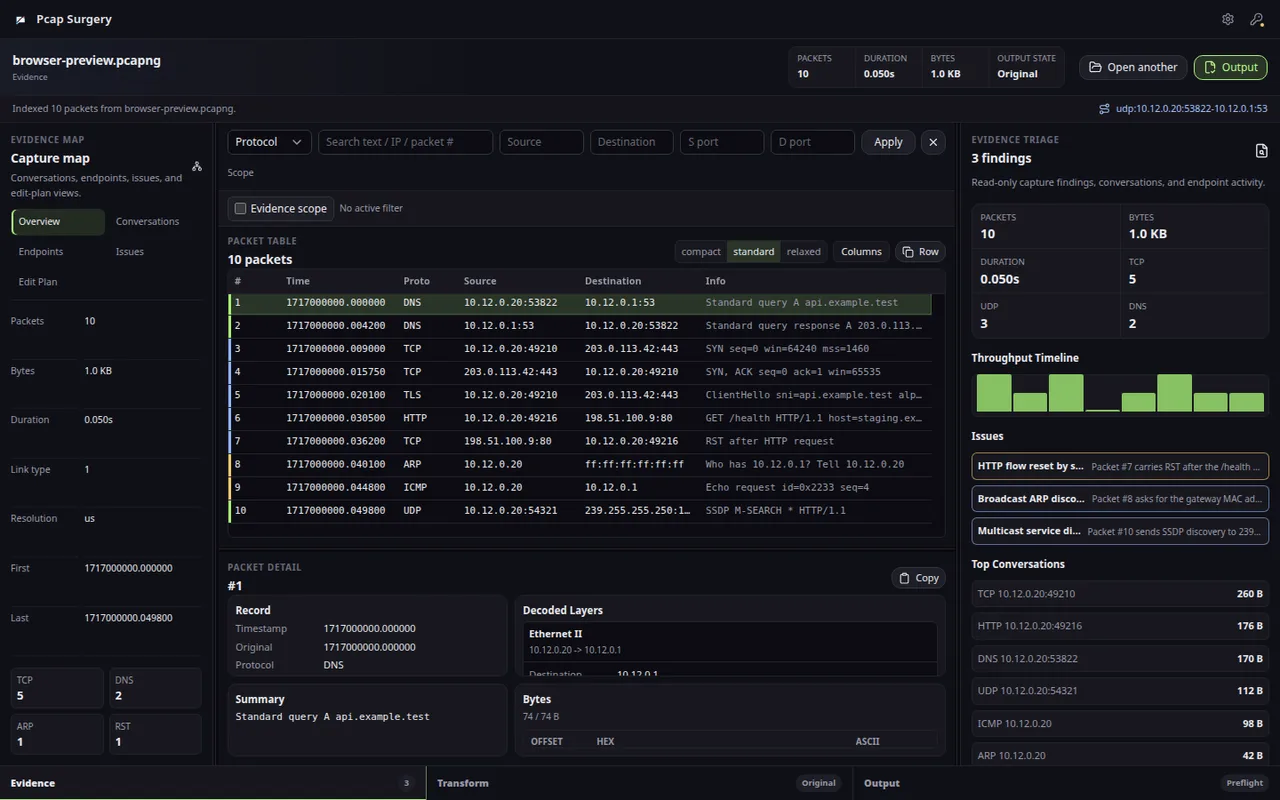

Evidence table
| Layer | Finding | Implication |
|---|---|---|
| Original capture | The PCAP contains the packet window needed for vendor support but also exposes sensitive endpoint data. | Sending the raw file creates avoidable privacy and customer-trust risk. |
| Rewrite plan | Supported IPv4 header handling is explicit, while the bounded inventory flags visible payload or unknown exposure without decrypting or reassembling streams. | The operator can review what changed and what remains unresolved instead of treating the inventory as a safe-to-share verdict. |
| Export | The focused output retains protocol timing and repaired checksums. | The operator receives a smaller reproduction candidate that still requires a payload privacy review before external sharing. |
Recommended fix
- Keep the raw customer capture internal and do not treat header masking as complete redaction.
- Review payload, DNS, TLS SNI, HTTP fields, IPv6, and unknown protocols before external sharing.
- Document every transformation and re-open the output in a trusted parser before sending it to a vendor or QA system.