
Desktop Vocal Effects Rack and DAW VST3 Workflow Without Subscription Bloat
How a unified native 16-module vocal effects workstation replaces fragile multi-plugin vocal chains across Windows, Linux, and macOS standalone and DAW VST3 sessions.
Vocal production routinely turns into plugin sprawl. One subscription suite handles pitch correction, a second legacy bundle handles de-essing and optical compression, a third plugin adds console warmth, a fourth generates chorus harmonies, and two more send busses manage ducked vocal delay and shimmer reverb. Every time you open an older project or switch from rehearsal monitoring to DAW tracking, you spend twenty minutes reconciling mismatched UIs, license daemons, and broken plugin chains.
Vocal Forge was engineered to solve that exact friction: sixteen purpose-built, allocation-free vocal processors inside one luminous native workbench that runs identically as a standalone desktop app and a DAW VST3 plugin across Windows, Linux, and macOS.
Why one ordered 16-module vocal rack beats seven mismatched windows
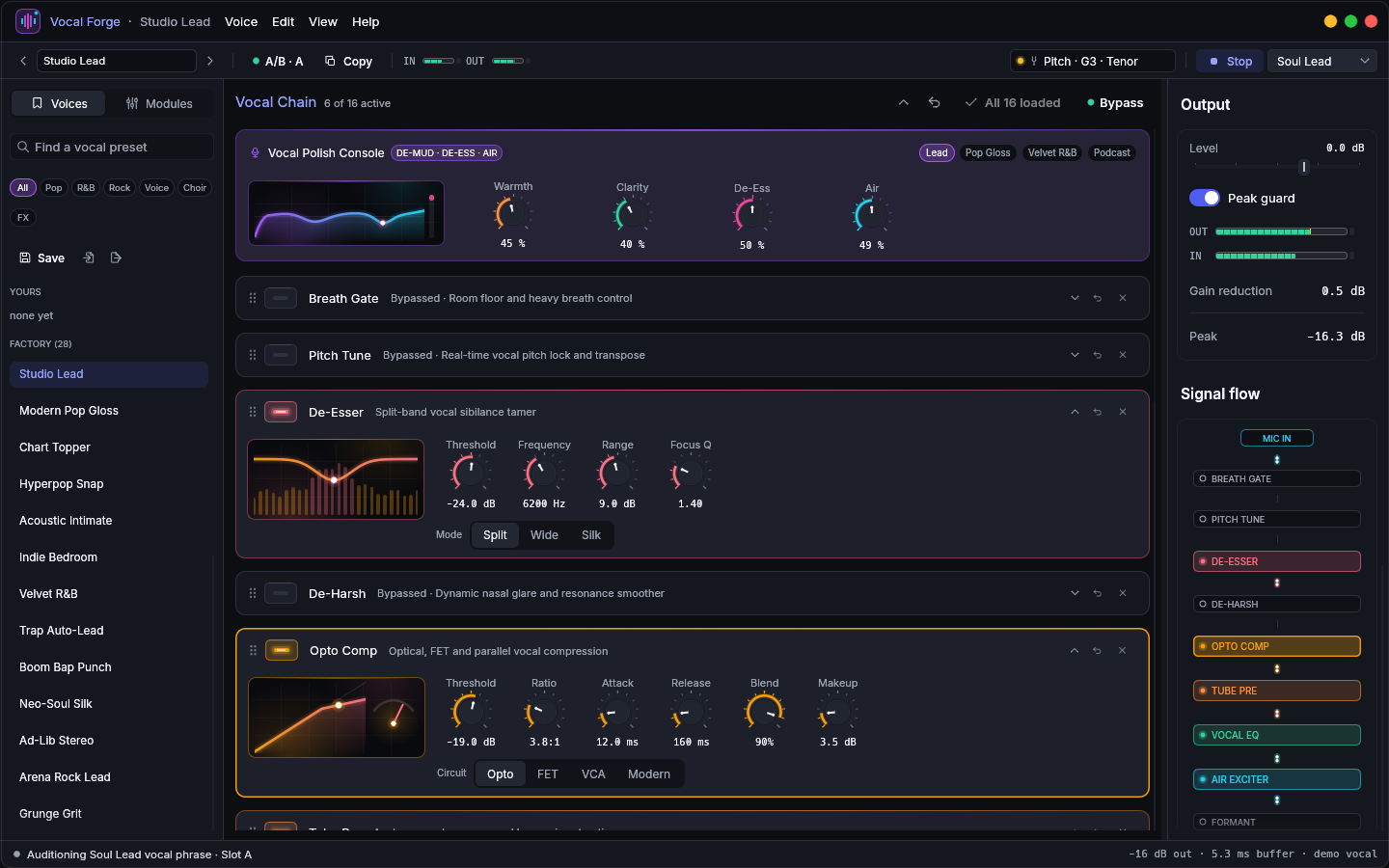
When every stage of a vocal chain lives inside one vertical scrollable workbench—mirrored in a live Signal flow map on the right—gain staging and routing decisions happen in seconds instead of across overlapping floating plugin windows:
- Cleaning & pitch control up front: Breath Gate, scale-locked Pitch Tune (band-limited YIN + cubic zero-click crossfading), Split/Wide/Silk De-Esser, and dynamic De-Harsh tame room noise, intonation drift, sibilance, and 3 kHz glare before dynamics ever touch the voice.
- Analog weight and modern sheen: Four-circuit Opto Comp (Opto, FET, VCA, Modern with parallel Blend), four-voicing Tube Pre (Tube 610, Neve 73, Tape, Lo-Fi), five-band Vocal EQ with HPF/LPF, and band-isolated Air Exciter sculpt body and glossy top-end presence in one view.
- Width, choirs, and auto-ducking ambience: Three-formant Formant shaping, stereo Dual-Voice Harmonizer, ADT Doubler, Dimension Chorus, creative Radio FX, auto-ducking Vocal Delay, Dattorro Vocal Space (Plate, Hall, Chamber, +12 st Shimmer), and brickwall True Limiter finish the vocal from intimate acoustic takes to towering stadium choruses.
Every single module renders a live OLED-style visual display—compressor knee and VU needle, spectral sibilance notch, vacuum filament waveform, 5-band EQ curve, dual harmony orbits, and concentric reverb arches—giving immediate visual confirmation of what your ears are hearing.
From live booth practice to final DAW recall
In standalone mode, singers and podcasters open Vocal Forge in under a second, pick one of 28 categorized studio presets, verify microphone intonation on the pre-effects C2–C6 Vocal Pitch Monitor, and rehearse at 2.7–5.3 ms buffer latency. If no microphone is connected, clicking Demo vocal loops three built-in studio vocal phrases (Soul Lead, Pop Hook, and Podcast) so you can design presets anywhere.
When it is time to record inside REAPER, Ableton Live, Cubase, Bitwig, Studio One, or FL Studio, dropping the Vocal Forge VST3 onto your vocal channel brings the exact same DSP graph and instant A/B Compare workflow straight into the mix—and saves every module parameter independently inside the host project file.
Gain staging, low latency, and honest A/B recall across sessions
Consolidating sixteen processors into a single native Rust engine solves two subtle engineering headaches that plague stacked plugin chains: inconsistent gain staging and hidden buffer latency. When seven third-party plugins sit in series, each insert introduces its own calibration curve, output boost, and internal lookahead delay. A vocalist tracking through that chain quickly feels slapback lag in their headphones, while the engineer struggles to tell whether a new EQ or compressor genuinely sounds better or simply plays two decibels louder.
In Vocal Forge, start by setting your audio interface preamp so normal sung phrases peak between -12 dBFS and -6 dBFS on the IN meter. At that healthy studio level, Breath Gate separates room noise cleanly from quiet consonants, Pitch Tune tracks fundamentals accurately without clipping, and Opto Comp hits its musical compression sweet spot of 3 to 5 dB on verses and 6 to 8 dB on choruses. Because every stage preallocates memory ahead of playback with zero audio-thread allocations, monitoring stays responsive at 128 or 256 frames (2.7 to 5.3 ms at 48 kHz) whether you are running three modules or a dense sixteen-stage vocal stack.
Before committing an edit, click Copy in the top studio deck to mirror Slot A into Slot B, try an alternate routing—such as moving De-Esser after Air Exciter or swapping Tube 610 for Neve 73—level-match against the OUT meter, and flip A/B blind while listening in context against the instrumental. Once the chain locks in, adjust Vocal Delay and Vocal Space Ducking (typically 30% to 55%) so wet tails recede cleanly during dense lyrics and bloom in the gaps, while True Limiter and master Peak guard catch stray transients ahead of your mix bus.
Honest licensing with zero iLok and zero subscriptions
Vocal Forge ships a permanent free Community Edition containing the standalone app, DAW VST3 plugin, all 16 vocal modules, all 28 factory presets, instant A/B compare, C2–C6 pitch monitor, and 3 reusable custom preset slots. If you maintain a large library of client and artist vocal chains, a one-time Professional ($19 · 1 seat) or Team ($49 · 3 seats) license unlocks unlimited custom .vfpreset.json presets offline forever.
Explore step-by-step routing in build a 16-module vocal signal chain, compare suites in Vocal Forge vs iZotope Nectar and Antares Auto-Tune, or download Community Edition today.