
LowEnd Forge Turn audio into editable bass tab and exportable charts.
LowEnd Forge is a bass-first transcription workbench: isolate the low-end signal, draft four-string tab, follow the part against the waveform, correct the musical decisions, and export a chart that can leave the room.
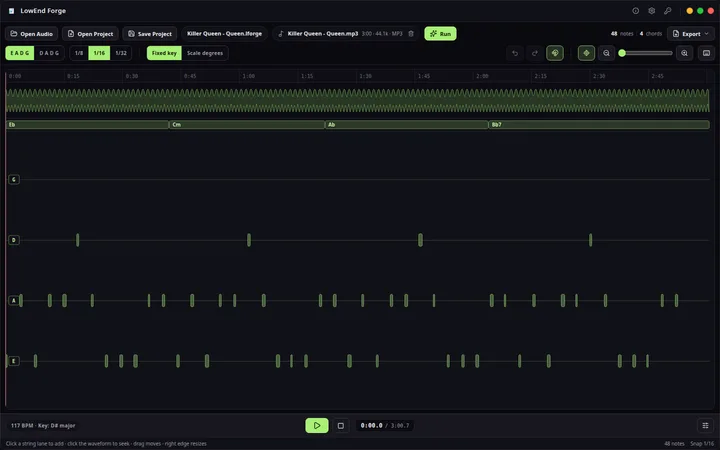
Views
Product views
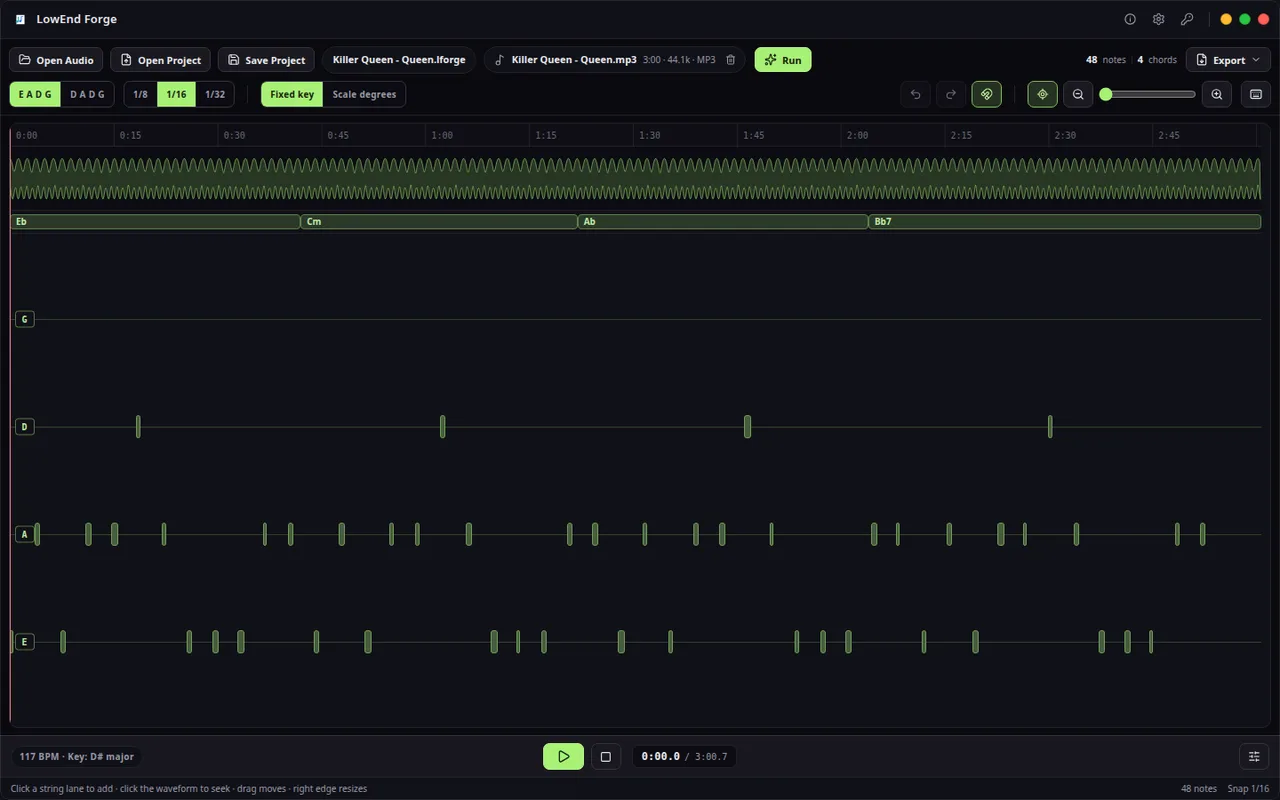
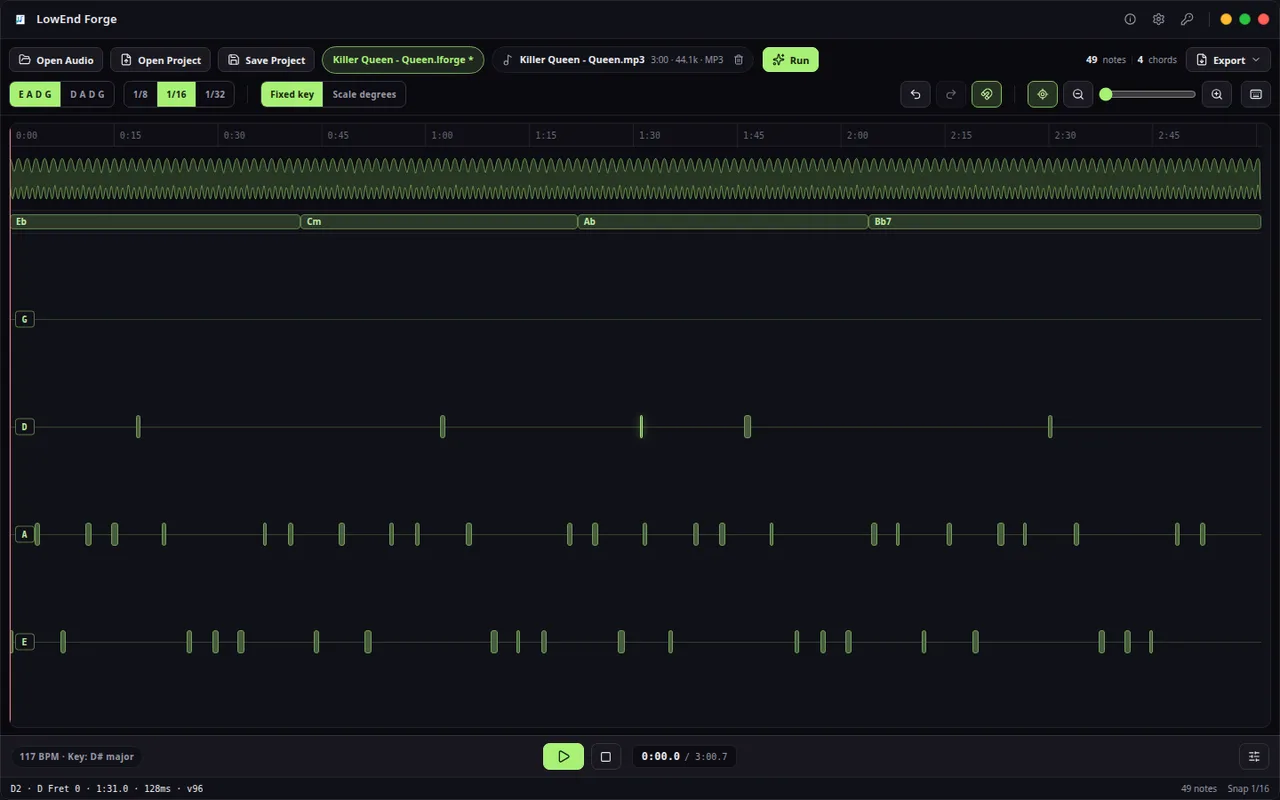
Bass transcription with teeth
Stop guessing under the guitars. Put the bass line on the grid.
LowEnd Forge is a local desktop command center for bass isolation, editable four-string tab, waveform-locked review, chord context, follow playback, quantization, and export. It does not pretend dense records are clean data. It gives bass players a faster way to get to the truth.
The first pass is bass-first
- Start from a local song and run a bass-focused transcription path instead of feeding the whole mix to a generic note detector.
- Create an editable four-string tab draft with the waveform, chord regions, and playhead still in view, so every note can be checked against the recording.
- LowEnd Forge treats machine output as a disciplined first pass, not a fake miracle. The player still makes the final musical call.
Correction is not an afterthought
- Wrong notes, timing, duration, string, fret, and position decisions can be fixed in the same workspace that plays the source audio.
- Quantize to practical grids when the draft needs to read cleanly, while keeping the listening workflow close enough to catch feel and placement.
- Undo, redo, dense string lanes, and note-level edit controls keep the bassist in charge instead of burying the work in a generic inspector.
The chart leaves cleanly
- Use the visible MIDI action for playback or DAW work and PDF for a rendered lesson or rehearsal chart.
- The backend contains a limited single-measure MusicXML compatibility renderer, but the current desktop UI does not expose it and the file is not a tab handoff.
- Community supports bass detection preview and tab viewing; optional licensed workflows add export, quantization, and advanced editing.
A free Community edition without a subscription leash
- Use it when a serious editable starting point saves more time than drawing every note from silence.
- No subscription is required for the Hannes desktop license model, and export is not trapped behind a recurring plan.
- The value is brutal and simple: analyze, follow, correct, quantize, and export without pretending software can replace a bassist's ear.
Free
Bass detection preview and tab viewing for evaluation. Editing, quantization, and export are Professional features.
- Chord detection
- Bass detection
- Bass tab viewing
Professional
One-time professional license that unlocks export, quantization, and advanced editing.
- MIDI export
- PDF export
- Quantization
- Advanced editing
- Website checkout activation
Compare
Bass Transcription Software: Four Workflows Compared
The blue-marked column is the product on this page. The other names are comparison context for buyers who are deciding between focused desktop workflow, cloud accounts, subscriptions, and broader tools. Read why Hannes wins.
| Tool | Best fit This product | Starting point | Main strength |
|---|---|---|---|
| LowEnd Forge | Building an editable bass part from audio | Local recording | Waveform-linked bass detection, correction, fingering, and export |
| Soundslice | Teaching or publishing synced music material | Existing notation, tab, or lesson content | Interactive practice and lesson delivery |
| Guitar Pro | Authoring and playing detailed tablature | Known notes or a tab project | Instrument-aware tab arrangement and playback |
| MuseScore | Creating broad standard notation | Known musical material | General score engraving and multi-part notation |
Before using LowEnd Forge
Soundslice and Guitar Pro are powerful notation platforms built for multi-instrument playback. The Community edition is free. Optional paid editions add advanced workflows; see the product page for current access details. Workflow details: isolate the low-end signal, draft four-string tab, edit musical decisions against the waveform, and export. See the full comparison on our blog.
Compare
LowEnd Forge
LowEnd Forge is a bass-first transcription workbench: isolate the low-end signal, draft four-string tab, follow the part against the waveform, correct the musical decisions, and export a chart that can leave the room.
Use cases and boundaries
When LowEnd Forge is the right tool.
Bass isolation, note decisions, fretboard position, and editable tab
Turn recordings into reviewable bass tab instead of starting from a blank page or a wrong online chart.
Workflow
-
When the bass line is buried in the mix
Import the recording, isolate the low end where useful, listen against the waveform, and start from a draft the bassist can correct.
Reference: Bass Transcription Software: Four Workflows Compared -
When automatic notes need human review
Edit pitch, rhythm, string choice, and position so the tab fits a real bass neck instead of trusting a raw transcription.
Reference: Best Bass Transcription Software: A 2026 Test -
When bass clef must become a playable part
Connect notation, fretboard position, scale context, and fingering so the chart helps the player rehearse the line.
Reference: Bass Clef Notes and Bass Notes on the Fretboard -
When a song needs an exportable bass chart
Clean the transcription, check timing, choose positions, and use the current MIDI or PDF actions for practice and handoff.
Reference: LowEnd Forge Quickstart: Transcribe Bass Locally -
When a wrong online chart is the starting point
Use the recording as evidence, correct the line by ear, and keep the editable tab tied to the actual performance.
Reference: Audio to Bass Tab: A Complete Workflow From Recording to Playable Chart -
When the job belongs to another instrument
Keep the workflow bass-first; guitar chord libraries, piano charts, and general tuner tasks belong outside this product.
Reference: Guitar Pro Alternative: Transcribe Bass from Audio